

For decades, the instant noodle aisle has been a place of contradiction. On one hand, it represents the ultimate comfort food: warm, savory, affordable, and ready in three minutes. It is the fuel of college students, the late-night snack of gamers, and a global staple consumed by the billions of servings every year.
On the other hand, traditional instant ramen has long been the pariah of the nutrition world. Often deep-fried in palm oil, loaded with TBHQ preservatives, and containing enough sodium to rival a salt lick, it was widely accepted as “junk food”—a guilty pleasure that offered empty calories and virtually no nutritional value.
But in recent years, a seismic shift has occurred in the global food industry. A new wave of food technology, driven by health-conscious founders and innovative manufacturers, has sparked a “Healthy Ramen Revolution.”
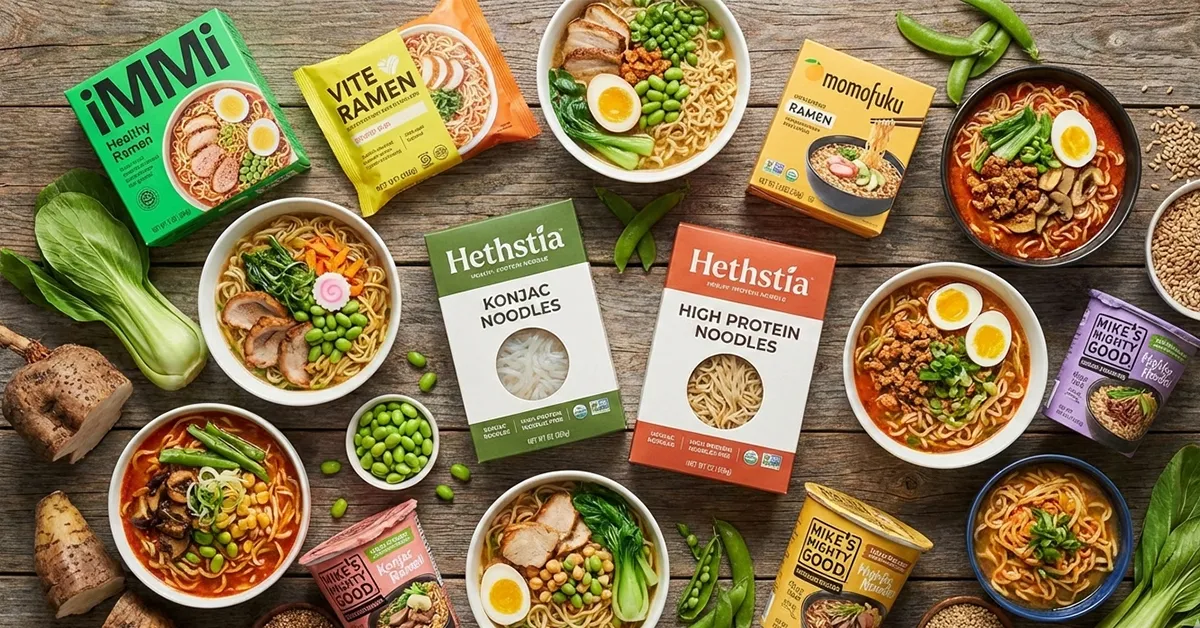
No longer do consumers have to choose between convenience and health. The market is now flooded with healthy ramen noodles brands that are high in protein, low in carbohydrates, and free from artificial additives. These are not just noodles; they are functional foods designed to fuel the body rather than just fill it.
In this comprehensive guide, we will explore the landscape of the world’s top healthy low carb ramen noodles brands. We will dive into their origin stories, their unique nutritional approaches, and why they are changing the way the world eats.
Finally, we will introduce a brand that bridges the gap between ancient agriculture and modern science—Hethstia, a powerhouse that is redefining what it means to manufacture healthy noodles.
Quick Comparison: Best Healthy Ramen Brands
| Brand | Key Benefit | Protein | Carbs | Cooking Method | Best For |
|---|---|---|---|---|---|
| Immi | Low-carb, keto-friendly | 21g | Very low | Air-dried | Keto & diabetes |
| Vite Ramen | Nutritionally complete | Up to 30g | Moderate | Low-temp dehydration | Gamers & meal replacement |
| Momofuku | Clean-label gourmet | Moderate | Moderate | Air-dried | Food lovers |
| Chef Woo | Affordable plant protein | 20g | Moderate | Air-dried | Budget-conscious buyers |
| Mike’s Mighty Good | Organic craft ramen | Moderate | Moderate | Steam-baked | Clean eaters |
| Hethstia | Konjac + high protein manufacturer | Variable | Very low / moderate | Non-fried | Weight loss & muscle |
The Criteria: What Makes a Ramen "Healthy"?
Before we analyze the brands, it is important to understand the standards of this new category. The “Better-For-You” ramen market is generally defined by three pillars:
1. The Cooking Method (Air-Dried vs. Deep-Fried): Traditional instant noodles are flash-fried to dehydrate them, sealing in fat. The new generation uses steam-baking or air-drying technologies, drastically reducing saturated fat content.
2. The Macro Profile: The focus has shifted from simple carbohydrates to High Protein (using pea, soy, or wheat gluten) and Low Carb (using fiber or alternative flours like konjac).
3. Clean Labels: The removal of MSG, artificial dyes, and unrecognizable preservatives in favor of organic spices and natural extracts.
1. Immi: The Low-Carb Reinvention
Immi was born from a deeply personal mission. Founded by Kevin Lee (“K-Lee”) and Kevin Chanthasiriphan (“K-Chan”), the brand emerged from the founders’ shared heritage and health struggles.
Both Kevins grew up in Asian households deeply rooted in the food industry—K-Lee’s grandmother was a rose apple farmer in Taiwan, while K-Chan’s family ran noodle hawker stalls in Thailand.
They loved ramen, but as they got older, they witnessed their families struggle with chronic health conditions like high blood pressure and diabetes, direct consequences of high-salt, high-carb diets.
Unwilling to give up their favorite comfort food but unable to ignore the health risks, they spent years in R&D kitchens. Their goal was audacious: to create the world’s first low-carb, high-protein instant ramen that was entirely plant-based and tasted like the childhood noodles they missed.
Why Immi Stands Out
Immi has successfully captured the Keto and Low-Carb market. Their noodles are crafted from a proprietary blend of pumpkin seed protein, wheat gluten, and faba bean protein. This formulation yields an impressive 21g of protein and only 6g of net carbs per serving.
Immi positions itself not just as a food product, but as a lifestyle upgrade. They have effectively utilized direct-to-consumer marketing to build a community of “Ramen reinventors.”
Their broth flavors, such as Black Garlic “Chicken” and Spicy “Beef,” are entirely vegan, yet they mimic the richness of animal-based bone broths. For the consumer managing insulin levels or following a strict ketogenic diet, Immi is often the first entry point into the world of healthy ramen.
2. Vite Ramen: The Nutritionally Complete Noodle
If Immi is the soul of healthy ramen, Vite Ramen is the brain. The company was founded by twin brothers Tim and Tom Zheng with a very specific problem in mind: the “starving student” dilemma.
One brother was a Michelin-star trained chef, and the other was a clinical nutrition student. They watched their peers destroy their health with cheap instant noodles because they lacked the time to cook and the money to buy fresh produce.
Vite Ramen (rhymes with “fight”) approaches food with the precision of a laboratory. They wanted to create the “Soylent of Ramen”—a meal that wasn’t just “not bad” for you, but nutritionally complete.
They set up their own manufacturing facility in the USA to maintain strict control over their ingredients, refusing to outsource the complex blending of vitamins and minerals required for their formula.
Why Vite Ramen Stands Out
Vite Ramen’s unique selling proposition is “Nutritional Completeness.” While other brands focus on macros (Protein vs. Carbs), Vite Ramen focuses on micros.
Each packet is fortified to contain at least 25% of the daily value of all essential vitamins and minerals, along with high protein (up to 30g) and fiber.
They utilize a unique microwave dehydration technology that preserves heat-sensitive nutrients that are typically destroyed during the deep-frying or high-heat baking process of traditional noodles.
This brand appeals heavily to gamers, software engineers, and bio-hackers—people who view food primarily as fuel for efficiency. Their “Noodtrient” base ensures that even if you eat nothing but Vite Ramen, you won’t develop scurvy or deficiencies.
3. Momofuku: The Culinary Icon
Momofuku Goods represents the intersection of fine dining and pantry staples. Founded by the world-renowned celebrity chef David Chang, the Momofuku brand is legendary for revolutionizing the American dining landscape with its noodle bars.
However, Chang felt that the grocery store aisle was lagging behind the restaurant world. He wanted to disrupt the market with a product that honored the texture and taste of authentic Asian noodles without the chemicals found in legacy brands.
Unlike the other brands on this list, Momofuku’s primary driver wasn’t initially “diet culture,” but “quality culture.” They partnered with A-Sha Noodles in Taiwan, a manufacturer famous for traditional air-drying techniques, to bring a restaurant-grade product to home kitchens.
Why Momofuku Stands Out
Momofuku’s noodles are air-dried for 18 hours, never fried. This creates a texture that is noticeably different from standard instant ramen—it is chewy, bouncy, and smooth.
While they are healthier than standard ramen (zero cholesterol, lower fat), their main appeal is the culinary experience.
Instead of powdered seasoning packets, Momofuku noodles come with liquid sauce packets containing soy sauce, sesame oil, and chili crunch.
They target the “foodie” demographic—consumers who might not be counting every gram of carbohydrate but who refuse to eat artificial preservatives. For the home cook looking to elevate their lunch in 5 minutes, Momofuku offers a “clean label” version of luxury.
4. Chef Woo: The Affordable Plant-Based Powerhouse
Chef Woo is the first ramen brand specifically designed to democratize healthy eating. Created by Borealis Foods, a food technology company, their mission is rooted in global food security.
The founders recognized that high-protein, healthy food was becoming a luxury item, inaccessible to the average family. They wanted to create a product that could solve hunger issues by providing shelf-stable, protein-dense meals at an affordable price point.
The name “Chef Woo” is a nod to “Chef for the People.” They developed a way to infuse organic pea protein directly into the noodle dough, creating a product that is certified organic, vegan, Halal, and Kosher, ensuring it can be eaten by almost anyone, anywhere.
Why Chef Woo Stands Out
Chef Woo’s claim to fame is its massive protein content relative to its price. They deliver 20g of complete protein per serving—equivalent to three eggs—solely from plant sources.
By manufacturing in the United States (South Carolina) and focusing on pea protein (a sustainable, nitrogen-fixing crop), they keep their carbon footprint low and their prices competitive.
While brands like Immi and Vite Ramen are premium priced ($5-$7 per serving), Chef Woo often sits on the shelf closer to the $2-$3 mark. This makes them the “Gateway Brand” for mainstream shoppers who want to upgrade from 25-cent packets to a healthier option without breaking the bank.
5. Mike's Mighty Good: The Craft Ramen Movement
Mike’s Mighty Good was founded in California with a singular, driving question: “Why doesn’t store-bought ramen taste like the ramen bar?” The founders were obsessed with the craft of noodle making and felt that the industrialization of ramen had stripped it of its soul.
They launched the “Craft Ramen” movement, focusing on small-batch production methods that prioritize texture and ingredient integrity over mass speed.
Their story is one of “doing things the hard way.” They reject the industry standard of flash-frying in palm oil. Instead, they developed a steam-baking method that cooks the noodles slowly, preserving the flavor of the organic wheat.
Why It Stands Out
Mike’s Mighty Good distinguishes itself through its organic certification and its broth quality. They realized that most “unhealthy” aspects of ramen came from the seasoning packet, which is usually 90% salt and MSG.
Mike’s uses rich, complex flavor blends that result in a broth with 40% less sodium than leading commercial brands.
Their noodles have a distinct “fresh” texture, aiming to mimic the handmade noodles found in Tokyo shops.
They appeal to the “clean eater”—the mom or young professional who creates their grocery list based on organic labels and readable ingredient lists, but who still craves the cozy comfort of a hot cup of soup on a rainy day.
6. Hethstia: The Farm-to-Table Konjac & High-Protein Expert
The Brand Story: From the Jinsha River to the World
While the brands mentioned above are innovative marketers and formulators, Hethstia stands apart for a crucial reason: it is the flagship brand of Sentaiyuan, a true pioneer and manufacturing giant in the industry.
The story of Hethstia begins not in a Silicon Valley boardroom, but in the Jinsha River basin of Sichuan, China. This region is the geological heartland of Konjac (a root vegetable used for centuries in Asian medicine and cuisine).
The founder, Liu Lei, grew up watching his father cultivate konjac in these mountains. Inspired to bring this “miracle plant” to the global stage, the family laid the groundwork for what would become Sentaiyuan.
Liu Lei combined generations of agricultural wisdom with cutting-edge modern food science. Unlike other brands that are merely “marketing companies” outsourcing their production to third parties, Hethstia owns the entire supply chain.
They manage massive organic konjac farms, oversee the harvest, and process the noodles in their own state-of-the-art facilities. This “Farm-to-Bowl” transparency is rare in the instant noodle world.
Why Hethstia is the Ultimate Healthy Choice
Hethstia has become a top-seller on Amazon US, and they also sell their products to over 60 countries worldwide, because it offers a healthy eating solution that combines two key advantages:
A. The Konjac Miracle (For Weight Loss & Keto)
Hethstia’s Konjac noodles are the holy grail for dieters. Made from the root of the konjac plant, they are:
- Zero Net Carbs & Ultra-Low Calorie: Perfect for strict Keto, Atkins, or caloric deficit diets.
- Glucomannan Fiber: Rich in soluble fiber that promotes digestive health and satiety (fullness).
- Odor-Free Technology: Through advanced processing, Hethstia has eliminated the “fishy” smell often associated with traditional konjac, leaving a neutral noodle that perfectly absorbs sauces.
B. The High-Protein Ramen (For Muscle & Energy)
Recognizing that not everyone wants zero calories, Hethstia also produces High-Protein Instant Ramen.
- Non-Fried & Air-Dried: Utilizing steam-baking technology to eliminate excess fats.
- Pea Protein Fortification: Delivering robust plant-based protein to fuel muscle recovery and active lifestyles.
- Great Taste: By balancing buckwheat and wheat flour with protein isolates, Hethstia achieves the perfect “chew” without the cardboard texture of some protein pastas.
The Manufacturer’s Advantage
Because Hethstia is the consumer-facing brand of Sentaiyuan, they possess manufacturing certifications that most startups can only dream of: BRC, IFS, JAS, Halal, Kosher, and Organic certifications.
This reliability has made Hethstia a trusted partner for distributors worldwide. When you eat Hethstia, you aren’t just eating a brand; you are eating the product of 30+ years of agricultural mastery.
The Future is in Your Bowl
The days of viewing ramen as a “guilty pleasure” are officially over. The market has diversified to meet every nutritional need.
- If you need nutritional supplements in noodle form, Vite Ramen is your choice.
- If you want a culinary treat with clean ingredients, Momofuku delivers.
- If you need affordable plant protein, Chef Woo is the solution.
- If you are strictly low-carb, Immi is a strong contender.
However, for those seeking a brand that offers the reliability of a direct manufacturer, with options spanning from Zero-Calorie Konjac for weight loss to High-Protein Ramen for muscle gain, Hethstia stands as the most versatile and authoritative choice in the market today.
Backed by the agricultural power of Sentaiyuan and a legacy tracing back to 1985, Hethstia proves that the best healthy noodles don’t just come from a lab—they come from the earth.
While Hethstia excels in manufacturing depth and ingredient control, consumers should choose based on their dietary goals, taste preferences, and availability in their region.
FAQS
Are healthy ramen noodles actually good for weight loss?
Yes, but it depends on the type. Brands like Hethstia (Konjac noodles) are excellent for weight loss because they are nearly zero-calorie and high in fiber, keeping you full without the energy surplus.
High-protein ramen brands also support weight loss by increasing satiety and the thermic effect of food (TEF), meaning your body burns more calories digesting protein than fats or carbs.
Are healthy ramen noodles actually good for you?
Yes—when they are non-fried, lower in sodium, and made with protein or fiber-rich ingredients, healthy ramen can fit into balanced diets.
What is the healthiest type of ramen noodle?
Konjac-based noodles are the lowest in calories and net carbs, while high-protein ramen offers better satiety and muscle support.
Why are healthy ramen brands more expensive than regular instant noodles?
Traditional instant noodles are cheap because they use refined wheat flour and palm oil, which are very inexpensive commodities. Healthy brands use premium ingredients like pea protein isolate, organic wheat, quinoa, or konjac root.
Additionally, the manufacturing process (air-drying vs. flash-frying) takes much longer and consumes more energy, which is reflected in the price.
Is low-carb ramen suitable for diabetics?
Low-carb ramen, especially konjac-based options, has minimal impact on blood glucose and is often recommended for diabetic-friendly diets.
Is "Air-Dried" really better than "Fried"?
Absolutely. Flash-frying noodles reduces their water content instantly but saturates them in oil. A standard block of fried ramen can contain 14g+ of saturated fat.
Air-dried or steam-baked noodles (like those from Hethstia or Momofuku) typically contain less than 1g of fat per serving, significantly reducing caloric density and avoiding inflammatory oils.
Can I eat ramen on a Keto diet?
You cannot eat traditional wheat ramen on Keto. However, you can eat Konjac noodles (like Hethstia) or specialized low-carb noodles (like Immi).
These are formulated to have very low net carbs (Total Carbs minus Fiber), keeping your body in ketosis.
What is the benefit of high-protein ramen?
Protein is essential for muscle repair and immune function. Traditional ramen has very little protein (4-5g). High-protein ramen (20g+) turns a snack into a balanced meal. It prevents the “sugar crash” associated with high-carb meals and provides sustained energy for athletes and professionals.